Most furnaces last about 15 to 20 years, and in Branchburg’s cold winters a failing one tends to give out at the worst possible time. If your furnace is over 15 years old, your heating bills are climbing, or repairs are stacking up, it is usually time to plan a new furnace installation before it quits. A proper install is not just a swap. It involves correct sizing, a township permit and inspection, and choosing an efficiency level that can earn you NJ rebates. This guide walks through all of it.
A furnace replacement is one of the bigger home expenses a New Jersey homeowner faces, so it is worth understanding before you are forced into it on the coldest night of the year. Here is how to know when it is time, what a good installation involves, and how to get it done right in Branchburg.
Signs you need a new furnace installation
A furnace rarely dies without warning. The trick is reading the signs before you are left without heat in January.
Age is the first one. Once a furnace passes 15 years, its odds of a major failure climb, and most are done by 20. Watch for heating bills that keep rising even though your usage has not changed, since a furnace loses efficiency as it wears. Uneven heat, where some rooms never warm up, points to a system struggling to keep up. Frequent repairs are another signal, and there is a simple rule of thumb: if a repair costs more than a third of a new furnace and the unit is old, replacing it usually makes more financial sense than patching it again. Strange noises, short cycling where the furnace turns on and off rapidly, and a burner flame that looks yellow instead of crisp blue all warrant a professional look. That yellow flame in particular can signal a combustion problem and should be checked promptly for safety.
Why Branchburg winters make furnace sizing matter
Here is something most homeowners never hear: bigger is not better when it comes to a furnace. This matters in a cold climate like Branchburg’s, where the system runs hard for months.
An oversized furnace heats the air fast, then shuts off, then kicks back on a few minutes later. This short cycling wears the unit out faster, wastes fuel, and leaves rooms unevenly heated. An undersized one runs constantly and still cannot keep up on the coldest nights. The right way to size a furnace is a Manual J load calculation, which factors in your home’s square footage, insulation, windows, and layout instead of guessing from the old unit. A contractor who sizes a furnace properly is doing the single most important thing for your comfort and your bills, and many NJ rebate programs now require that load calculation anyway.
What a residential furnace installation actually involves:
A professional residential furnace installation is a structured process, not a quick part swap. Knowing the steps helps you spot a contractor who is cutting corners.
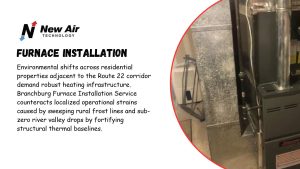
It starts with an in-home assessment and a load calculation to size the unit. Then the old furnace is disconnected and removed, and the new unit is set, connected to the gas line, ductwork, electrical, and venting; and tested. Newer high-efficiency condensing furnaces also need a condensate drain and often different venting than an older furnace, which is why the install is more involved than a basic replacement. One step that is not optional in New Jersey: the work requires a township permit and a municipal inspection. A licensed contractor pulls the Branchburg permit and schedules the inspection as part of the job. If an installer wants to skip the permit to save time, that is a red flag, because unpermitted work can cause problems with insurance and when you sell the home.
High-efficiency furnaces and NJ rebates worth knowing about
Furnace efficiency is measured by AFUE, the percentage of fuel actually turned into heat. An older furnace might run at 80% AFUE, while a modern high-efficiency condensing furnace runs at 95% or higher, which means less gas wasted every month through a long NJ winter.
That higher efficiency also unlocks money back. As of 2026, New Jersey utility programs offer rebates for installing a qualifying high-efficiency gas furnace, generally in the range of about $540 up to $900 depending on your utility, with the highest-efficiency units and combi systems reaching up to roughly $1,750. On top of that, a federal tax credit can cover 30% of the cost of a qualifying high-efficiency furnace, capped at $600. Most of these programs require the new unit to be a high-efficiency condensing model, a Manual J load calculation, and installation by a participating licensed contractor. The exact amounts and rules change with funding, and your specific rebate depends on which utility serves your Branchburg address, so confirm current numbers before you buy. A good local installer will tell you which rebates you qualify for and help with the paperwork.
A note on oil-to-gas conversions
Plenty of older homes in this part of New Jersey still run on oil heat. If that is you, replacing an aging oil furnace can be a chance to convert to natural gas, which is usually cheaper to run and cleaner. A conversion is more involved than a straight furnace swap, since it can include a new gas line and venting changes, so it needs a contractor experienced with conversions specifically. It is worth asking about if your current system burns oil.
Finding a furnace installation service near me in Branchburg: what to check
When you search for furnace installation service near me, do not pick on price alone, especially for a system that has to survive a New Jersey winter. A few things worth confirming before you hire:
Make sure the contractor is licensed and insured in New Jersey, since furnace work involves gas and combustion and is not a place to gamble. Confirm they perform a Manual J load calculation rather than just matching your old unit’s size. Check that they pull the township permit and handle the inspection. Ask whether they help you claim available NJ rebates and tax credits. And read recent reviews from local homeowners. Get the full scope and warranty in writing before work begins.
If you want a local team that handles all of that, that is what we do. You can see options and schedules for our furnace installation service in Branchburg NJ page.
Frequently asked questions
How much does furnace installation cost in Branchburg, NJ?
It depends on the size of your home, the efficiency level you choose, and whether any ductwork, venting, or a gas conversion is needed. A high-efficiency unit costs more upfront but lowers monthly bills and can qualify for NJ rebates and a federal tax credit that offset part of the cost.
How long does a furnace installation take?
A straightforward replacement is often done in a day. Jobs that involve new venting, a condensate drain for a high-efficiency unit, or an oil-to-gas conversion can take longer.
Do I need a permit to replace a furnace in New Jersey?
Yes. Furnace installation in New Jersey requires a township permit and a municipal inspection. A licensed contractor handles this as part of the job. Skipping it can cause issues with insurance and home sales later.
Is a high-efficiency furnace worth it in New Jersey?
For most Branchburg homes, yes. A 95% AFUE or higher furnace wastes less fuel across a long, cold winter, and the available NJ rebates plus the federal tax credit help close the gap on the higher purchase price.
Plan your furnace installation before the cold hits
The worst time to replace a furnace is the night it dies in January. If your system is aging or struggling, it is far cheaper and calmer to plan a new furnace installation now. New Air Technology handles residential furnace installation in Branchburg, including proper sizing, permits, high-efficiency units, and rebate guidance. See our furnace installation service in Branchburg NJ or call +19085668771 to schedule an assessment.