If your air conditioner is under about 10 years old and the repair is small, fix it. If it is 12 years or older, needs an expensive repair, or still runs on old refrigerant, replacement is usually the smarter money. There is also a 2026 wrinkle worth knowing before you decide: new systems use a different refrigerant than the one your old unit probably has, which changes the math on repairs. This guide breaks the decision down so you are not guessing on the first hot day.
It is the first real heat wave of a Branchburg summer, the house will not cool down, and a technician is standing in your driveway giving you a number. Repair or replace? That is a stressful call to make under pressure, so it helps to think it through before you are sweating in an 85-degree living room. Here is the honest version.
The repair-or-replace math
Forget gut feeling for a second. There is a rough formula that takes the emotion out of this.
Look at the age of the unit and the cost of the repair together. A common industry guideline is the 50% rule: if a repair costs more than half the price of a new system, replacement is the better investment. Another quick test is to multiply the repair cost by the age of the unit. A high number points toward replacing. A 4-year-old AC with a $400 repair is an easy fix. A 14-year-old unit needing an $1,800 compressor or a refrigerant leak repair is usually throwing good money after bad because the rest of the system is not far behind.
Age alone tells you a lot. Most central air conditioners last around 12 to 15 years in our climate. Past that, you are on borrowed time, efficiency has dropped, and parts get harder to find. If you are already calling for a repair every summer, the unit is telling you something.
Regarding the refrigerant change in 2026, the buyer needs to understand
This is the part that surprises people, and it is the single biggest reason the repair-or-replace decision is different in 2026 than it was a few years ago.
For about two decades, home AC systems ran on a refrigerant called R-410A. As of January 2025, manufacturers stopped building new residential systems that use it because of its high environmental impact. New equipment now uses a next-generation refrigerant, usually R-454B, and R-32 in many ductless mini-splits. Here is what that means for you in plain terms.
If your current system uses R-410A, it is not illegal, and you do not have to rush to replace it. It can still be serviced and recharged. But the price of R-410A refrigerant is climbing as supply shrinks, so a repair that involves a refrigerant leak on an older unit is getting more expensive, and that trend continues. You also cannot simply pour the new refrigerant into an old system. The new refrigerants run at different pressures and need equipment built for them, so the only way to get a new-refrigerant system is to replace the unit. For a homeowner staring at a costly repair on an aging R-410A system, that shrinking-supply reality often tips the decision toward replacing now rather than paying rising refrigerant costs on borrowed time. One more note: the new refrigerants are mildly flammable by classification, which sounds scary but is safe in a properly installed system, and new equipment includes leak detection built for it.
What SEER2 actually does to your electric bill
If you do replace, efficiency is where a new unit pays you back through every humid New Jersey summer.
Cooling efficiency is measured by SEER2. An old unit from the mid-2000s might run at a SEER2 equivalent in the low teens or worse, while a modern system runs much higher. The higher the number, the less electricity it burns to cool the same house. Over a full Branchburg cooling season, that difference shows up on every PSE&G or JCP&L bill. You do not need to chase the absolute highest rating, but jumping from a tired old unit to a modern, efficient one is usually where the real monthly savings live. A good installer will help you find the sweet spot between upfront cost and long-term savings for your home.
Why a bigger AC will actually make you less comfortable
Here is a counterintuitive one that matters more in humid New Jersey than people expect. When it comes to air conditioning, being oversized is a problem, not a bonus.
An air conditioner does two jobs: it cools the air and it pulls humidity out of it. An oversized unit cools the air so fast that it shuts off before it has run long enough to remove the moisture. The result is a house that feels cold and clammy at the same time, plus a system that short cycles and wears out early. In a Branchburg summer, where humidity is half the discomfort, proper sizing is what makes a home feel genuinely comfortable, not just cold. That is why a real installer does a load calculation for your specific home instead of just matching the size of your old box.
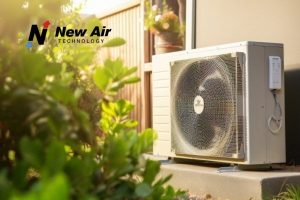
AC replacement and NJ rebates
Money back is smaller on straight central AC than on heating equipment, but it is still worth claiming. As of 2026, New Jersey utilities offer modest rebates for high-efficiency central air conditioners that meet the SEER2 requirements, often in the range of roughly $60 to $200 depending on your utility and the unit’s tier. A federal tax credit can also cover 30% of the cost of a qualifying high-efficiency AC, capped at $600.
If you are open to it, this is also the moment to ask about a heat pump. Heat pumps cool your home in summer and heat it in winter, and New Jersey is pushing them hard, so their rebates are far larger than the central AC ones. For some Branchburg homes a heat pump ends up being the better long-term value. Amounts and rules change with funding, so confirm current numbers for your address before you buy.
When is the best time to replace an AC in New Jersey?
Timing is a quiet way to save money and stress. The worst time to shop for an air conditioner is the moment yours dies in a July heat wave, when every contractor is slammed and you have zero leverage.
The smart window is the shoulder season: spring or fall, before the summer rush. You get easier scheduling, more time to compare options and rebates, and a calmer decision. If your unit limped through last summer, planning a replacement in the off-season beats an emergency call in peak heat. This is especially true for an aging R-410A system you already know is on its last legs.
Choosing AC replacement near me in Branchburg: what to check
When you search for AC replacement near me, do not decide on the lowest quote alone. A few things worth confirming before you hire:
Make sure the contractor is licensed and insured in New Jersey. Confirm they do a proper load calculation to size the system instead of copying your old unit’s size. Ask which refrigerant the new system uses and make sure their technicians are trained and equipped for the new A2L refrigerants. Check that they pull the required township permit and handle the inspection. Ask whether they help you claim NJ rebates and the federal tax credit. And read recent local reviews. Get the full scope and warranty in writing.
If you want a local team that covers all of that, that is what we do. You can compare options and schedule our air conditioning replacement service in Branchburg, NJ page.
Frequently asked questions
Should I repair or replace my air conditioner?
If the unit is under about 10 years old and the repair is minor, repair it. If it is 12-plus years old, needs an expensive repair, or runs on old R-410 For a refrigerant with a leak, replacement usually makes more financial sense. The 50% rule is a good guide: if the repair costs more than half a new system, replace.
Do I have to replace my AC because of the refrigerant change?
No. Existing R-410A systems are legal and can still be serviced. You are not forced to replace anything. The change only means new systems use a different refrigerant, and that repairs involving R-410A refrigerant are getting pricier as supply tightens.
How much does air conditioner replacement cost in Branchburg?
It depends on the size of your home, the efficiency level, and any ductwork changes. New systems cost somewhat more than they did a few years ago, partly due to the refrigerant transition, but high-efficiency units lower your summer bills and can qualify for NJ rebates and a federal tax credit.
What size air conditioner do I need?
The right size comes from a load calculation based on your home’s square footage, insulation, windows, and layout, not from the size of your old unit. Bigger is not better, since an oversized AC leaves your home humid and clammy.
Make the call before the first heat wave
The repair-or-replace decision is far easier when you make it on a mild spring day instead of in a July emergency. If your AC is aging, leaking, or limping into another summer, it is worth getting a straight assessment now. New Air Technology handles air conditioner replacement in Branchburg, including honest repair-or-replace advice, proper sizing, the new refrigerant systems, and rebate guidance. See our air conditioning replacement service in Branchburg, NJ, or call (908) 373-8305 to book an assessment.